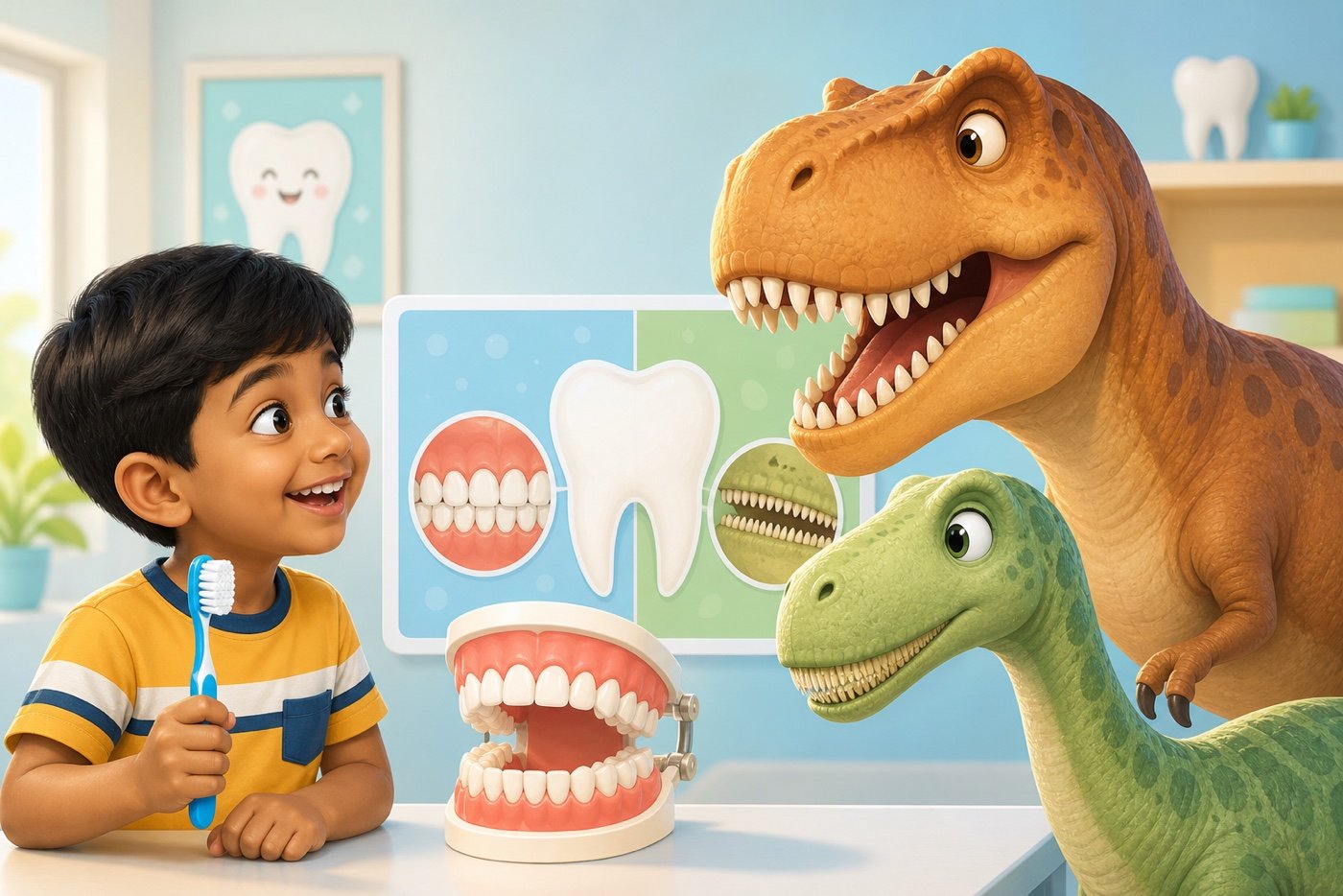
What if you opened your mouth and found more than 500 teeth inside?
Sounds impossible, right? For humans, it is. Children normally develop 20 baby teeth, while adults can have up to 32 permanent teeth. But one unusual plant-eating dinosaur called Nigersaurus had more than 500 active and replacement teeth packed into its jaws.
And that is only the beginning. Some dinosaurs had giant teeth for gripping and crushing. Others had hundreds of tiny teeth for eating plants. Some continually replaced teeth that wore out.
How Many Teeth Do Humans Have?
Let us start with your own smile.
Children normally have 20 baby teeth
Humans usually develop 20 primary teeth, more commonly called baby teeth. These teeth begin appearing during infancy and help children chew, speak and hold space for permanent teeth developing underneath.
Adults can have up to 32 permanent teeth
A full adult dentition contains 32 permanent teeth, including four wisdom teeth. That means an adult can have 8 incisors, 4 canines, 8 premolars and 12 molars including wisdom teeth.
Not every adult actually has 32 teeth. Some people never develop all their wisdom teeth, while others have them removed.
What Dinosaur Had 500 Teeth?
The answer is Nigersaurus.
Nigersaurus was a long-necked, plant-eating dinosaur that lived roughly 110 million years ago in what is now Niger in Africa. Its mouth looked very different from many movie dinosaurs: it had an unusually broad muzzle with teeth concentrated toward the front of the jaws.
When scientists describe Nigersaurus as having more than 500 teeth, that number includes working teeth plus replacement teeth waiting inside the jaws. Think of it like having lots of spare pencils ready whenever the pencil you are using becomes too short.
Human Teeth vs T. Rex Teeth: Who Had More?
Tyrannosaurus rex is one of the most famous dinosaurs of all. A full adult human mouth can contain up to 32 teeth. T. rex had about 60 pointed teeth, and some were very large.
So in the number challenge, T. rex beats humans. But Nigersaurus still leaves both far behind when active and replacement teeth are counted.
Why Do Humans Have Different-Shaped Teeth?
Look carefully at your smile and you will notice that not every tooth looks the same. That is because different teeth have different jobs.
- Incisors: front teeth that help bite and cut food.
- Canines: pointed teeth that help grip and tear food.
- Premolars: adult teeth that help tear, crush and grind food.
- Molars: broad back teeth that do much of the heavy chewing and grinding.
Humans do not have hundreds of replacement teeth, but our teeth form a highly organized chewing team.
Did Triceratops Have Teeth?
Yes. The front of a Triceratops mouth had a sharp beak-like structure, which can make people think it had no teeth. But farther back in its jaws were rows of teeth that helped process tough plants.
Triceratops did not have huge T. rex-style teeth. Its dental equipment matched its vegetarian menu.
Which Dinosaurs Had Hundreds of Teeth?
Nigersaurus was not the only dinosaur with an amazing dental system. Hadrosaurs, often called duck-billed dinosaurs, developed complex tooth arrangements known as dental batteries.
These were groups of tightly packed teeth and replacement teeth that helped the animals keep processing large amounts of vegetation.
Did Dinosaurs Lose Teeth Like Kids Do?
Yes, but the process was very different. Children normally begin with baby teeth, and those baby teeth are gradually replaced by permanent teeth as they grow.
Many dinosaurs could replace teeth repeatedly throughout life. Nigersaurus is an extreme example, with replacement teeth constantly developing in its dental batteries.
Got a little dinosaur with a big tooth question?
If your child has tooth pain, cavities, delayed eruption, broken teeth or questions about baby teeth, Little Bites Clinic can guide you with age-appropriate dental advice.
WhatsApp UsBonus Fun Teeth Facts for Kids
- Sharks can replace thousands of teeth. They continually shed and replace teeth during life.
- Great white sharks can have around 300 teeth. These may be arranged in several rows.
- Elephants have a dental conveyor belt. Their cheek teeth gradually move forward as older teeth wear down.
- Snails do not chew like humans. They use a tongue-like structure called a radula with tiny scraping ridges.
Dinosaur Tooth Challenge
Can you remember the answers?
- How many baby teeth do children normally have?
- How many permanent teeth can an adult have?
- Which dinosaur had more than 500 active and replacement teeth?
- Did Triceratops actually have teeth?
- Why did some plant-eating dinosaurs need replacement teeth?
Human Teeth vs Animal Teeth Comparison
| Creature | Tooth count or setup | What the teeth did |
|---|---|---|
| Child | 20 primary teeth | Bite, chew, support speech and hold space |
| Adult human | Up to 32 permanent teeth | Cut, tear, crush and grind |
| T. rex | About 60 teeth | Grip, tear and crush |
| Nigersaurus | More than 500 active and replacement teeth | Process low-growing vegetation |
| Triceratops | Rows of teeth behind a beak | Clip and process tough plants |
| Great white shark | About 300 teeth in rows | Grip and tear prey |
What Can Dinosaurs Teach Us About Looking After Our Teeth?
Here is the most important lesson in this toothy adventure: you do not have a dinosaur supply of replacement teeth.
A dinosaur could lose a worn tooth and already have another developing behind it. Once a human permanent tooth is lost, the body does not normally grow another natural permanent tooth to replace it. That is why looking after permanent teeth is so important.
Brush twice every day
Children should brush twice daily with an age-appropriate amount of fluoride toothpaste. Young children need adult supervision so they use the right amount and clean all surfaces properly.
Clean between teeth that touch
Once two teeth touch, brushing alone may not clean the contact area properly. Parents usually need to help young children clean between teeth.
Keep sugary snacks and drinks from becoming too frequent
Cavity-causing bacteria use sugars from foods and drinks to produce acids that attack tooth enamel. The goal is not to make childhood joyless, but to avoid frequent sugar exposure throughout the day.
Visit your dentist according to your child needs
Children differ in cavity risk, tooth eruption patterns, habits and dental needs. A dentist can recommend an appropriate check-up schedule for each child.
The Great Dinosaur Tooth Quiz
- How many baby teeth do children normally have?
Answer: 20 baby teeth. - How many permanent teeth can an adult have, including wisdom teeth?
Answer: Up to 32 permanent teeth. - What dinosaur is famous for more than 500 active and replacement teeth?
Answer: Nigersaurus. - How many teeth did T. rex have?
Answer: About 60. - True or false: Triceratops had no teeth because it had a beak.
Answer: False. It had a beak at the front and rows of teeth farther back.
Final Takeaway
Dinosaur teeth are exciting, but they also give kids a simple dental-health lesson. Humans get baby teeth and then permanent teeth. We do not have hundreds of replacement teeth waiting in the jaw.
So the next time your child asks why brushing matters, you have a fun answer: because you are a human, not a Nigersaurus, and you do not have 500 replacement teeth waiting for you.
References
- American Dental Association - MouthHealthy tooth eruption charts and children's healthy habits guidance.
- American Academy of Pediatric Dentistry - use of fluoride policy.
- Cleveland Clinic - human tooth types and tooth functions.
- PLOS ONE - Nigersaurus taqueti scientific description and University of Chicago / Paul Sereno - Nigersaurus discovery resource.
- Natural History Museum, London - Tyrannosaurus, Triceratops, Parasaurolophus, hadrosaur replacement teeth, and snails and slugs.
- Smithsonian - shark tooth facts, great white shark facts, and Asian elephant tooth facts.
- American Dental Association - flossing guidance and cavity prevention information.
Author / medical reviewer: Dr. Nikitaa Dhingra Sanan, BDS, MDS - Pediatric Dentist
Clinic: Little Bites Dental Clinic, Faridabad
Last medically reviewed: 21 August 2026
Medical disclaimer: This article is intended for general educational information only and should not be used as a substitute for examination, diagnosis or treatment by a qualified dental professional.