When a patient loses part of the upper jaw because of a tumour, cancer surgery, trauma or a congenital defect, rebuilding the bone is only one part of treatment.
The real clinical question is: will the reconstructed jaw ultimately support functional teeth, a stable bite, speech and acceptable facial form?
A published Cleveland Clinic case study provides an excellent example of why maxillofacial reconstruction should often be planned with the final dental result in mind from the beginning. Their multidisciplinary team brought together reconstructive surgeons and a maxillofacial prosthodontist rather than treating surgery and teeth as two unrelated stages.
- Dr. Nikitaa Dhingra Sanan, Little Bites Dental Clinic, Faridabad
The Clinical Problem: Rebuilding a Jaw Is Not Enough
In routine dentistry, replacing a missing tooth with a bridge, denture or dental implant is usually planned around relatively normal jaw anatomy. Complex maxillofacial defects are different.
- Part of the upper or lower jaw may be missing
- Several teeth may be missing
- Palatal tissue may be lost
- Supporting facial bone may be reduced
- Soft tissue needed for lip or cheek support may be affected
Cancer surgery and radiation can further affect healing, saliva production and the ability to retain conventional dentures. That means the surgeon cannot think only about where bone will fit. The team must also ask where the final teeth need to be.
Case Study 1: Planning From the Final Teeth Backward
Cleveland Clinic reported the case of a 29-year-old patient who had undergone removal of a congenital palate teratoma during infancy. He was left with a significant midface and maxillary defect and was missing upper front teeth.
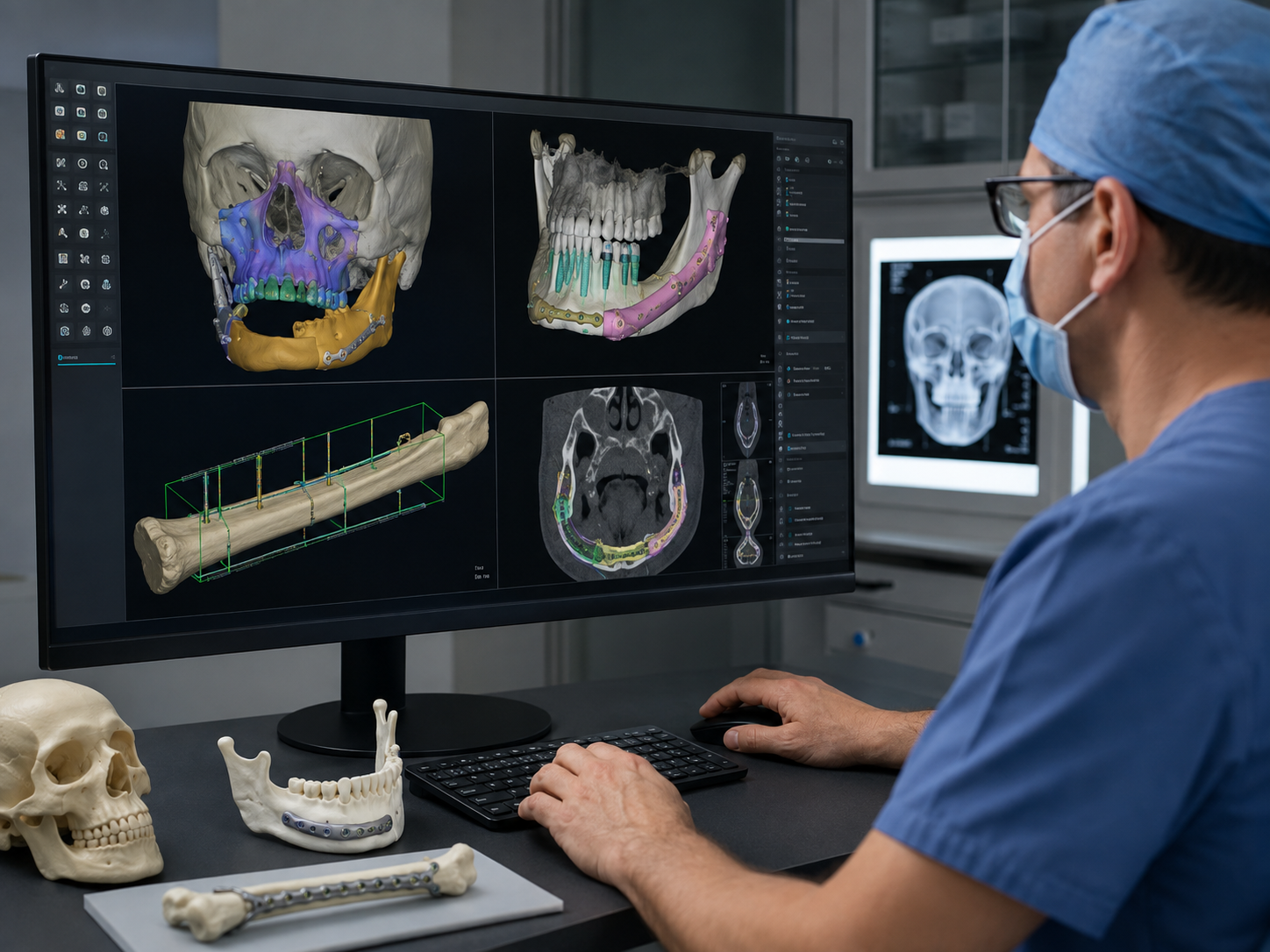
Instead of beginning with the bone graft, the team first established the ideal position of the future teeth and upper lip using a partial denture. That dental setup was digitally scanned and combined with cone-beam CT information showing the underlying bone.
The workflow became: final tooth position, then implant position, then reconstructed bone position. The patient later underwent maxillary surgery, fibula free-flap reconstruction and dental implant placement.
Why This Matters From a Prosthodontic Perspective
This case demonstrates something patients rarely hear about: the position of the bone should sometimes be dictated by the position of the future teeth.
- Implants may otherwise end up too far toward the cheek or palate
- The angulation may be unfavourable
- The bone may be too high or too low
- The final restoration may be difficult to design
- The result may be hard for the patient to clean
The dental prosthesis may then require compromises in appearance, speech or bite even if the reconstructive surgery itself was technically successful.
Need guidance for complex restorative planning?
Book a dental assessment at Little Bites Clinic to understand whether your case needs routine care, specialist planning or referral.
WhatsApp UsCase Study 2: Dental Implants During Cancer Reconstruction
The same Cleveland Clinic report describes a 78-year-old with a rapidly enlarging tumour involving the anterior palate. The cancer operation required removal of the palate and maxillary teeth followed by fibula free-flap reconstruction.
Here, timing became critical. Conventional complete dentures can be difficult to retain when normal maxillary anatomy has been extensively altered. Radiation-related dry mouth can make this even more challenging.
Because later implant placement could become more complicated, the surgical and prosthodontic teams placed dental implants during the cancer-resection and reconstruction operation.
The lesson is not that implants should be placed immediately in every cancer patient. The real lesson is that future dental rehabilitation should be discussed before major ablative surgery whenever possible.
Why Is the Fibula Used to Reconstruct a Jaw?
Both Cleveland Clinic cases used a fibula free flap, in which vascularised bone from the lower leg is transferred to reconstruct part of the jaw while maintaining its blood supply.
The transferred fibula can be shaped into segments that reproduce missing jaw anatomy, and in selected cases it can provide bone capable of supporting dental implants.
What Role Does 3D Planning Play?
Modern digital workflows may involve CT or CBCT scans, intraoral scans, digital dentures or planned teeth, virtual implant placement, virtual bone reconstruction, 3D-printed models, surgical cutting guides and patient-specific hardware.
Technology assists the team; it does not replace clinical expertise. Digital planning still needs experienced judgement from surgical, prosthodontic and restorative clinicians.
Why Should a Prosthodontist Be Involved Early?
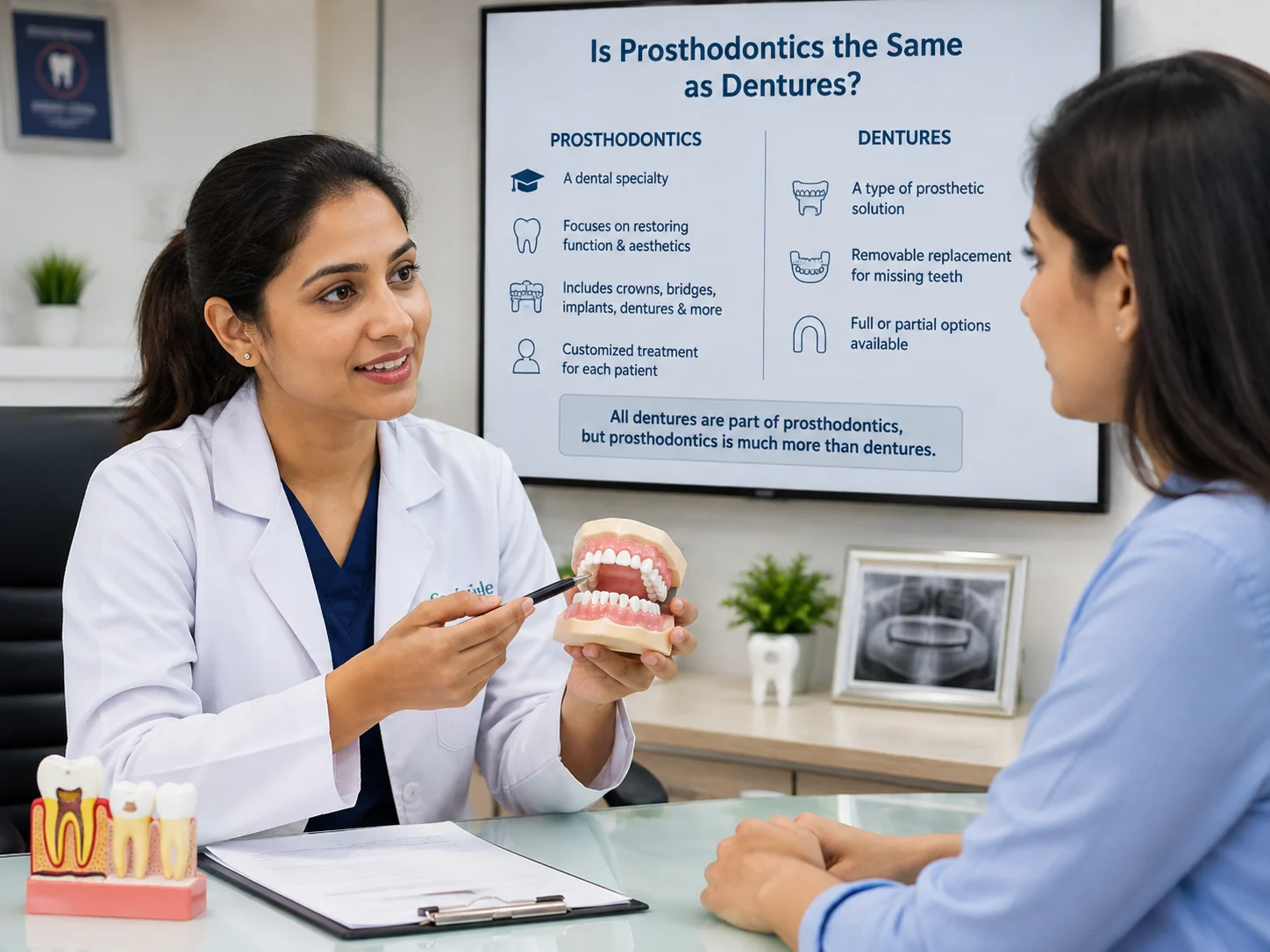
A prosthodontist or restorative dentist involved in complex reconstruction thinks beyond the operation itself.
- Where should the final teeth sit?
- What bite should be created?
- Will the lips receive enough support?
- Can the patient clean around implants?
- Will the prosthesis be fixed or removable?
- Will the reconstructed anatomy allow speech and chewing?
- Can the restoration be repaired or maintained later?
These decisions can directly influence implant and bone position.
What This Case Teaches Us at Little Bites Dental Clinic
Complex microvascular maxillofacial reconstruction belongs in a multidisciplinary tertiary-care setting with appropriately trained surgical, oncology and prosthodontic teams.
At Little Bites Dental Clinic in Faridabad, our role is not to suggest that every complex facial reconstruction can or should be managed within a routine dental clinic. The broader lesson is that treatment should begin with the final goal.
- Treatment should begin with the final functional outcome.
- Teeth cannot be planned independently of bone and soft tissue.
- Complex cases benefit from multidisciplinary thinking.
- Technically possible does not always mean restoratively ideal.
- Referral is part of good dentistry when a higher level of care is needed.
When Should a Patient Seek a Multidisciplinary Maxillofacial Opinion?
- A major jaw tumour
- Planned oral-cancer surgery
- Loss of a large section of the jaw
- Severe facial trauma
- A congenital maxillofacial defect
- Previous failed reconstruction
- Radiation-related jaw damage
- A need for implants within reconstructed bone
These are very different from routine cases involving a single missing tooth, straightforward dentures or standard implant treatment.
Key Takeaway
Do not reconstruct first and think about teeth later. When possible, plan the final teeth first and reconstruct toward that goal.
For patients in Faridabad and Delhi NCR, Little Bites Dental Clinic provides assessment for restorative and prosthodontic concerns and can help determine when a case requires coordinated specialist or tertiary-care referral.
References
- Cleveland Clinic Consult QD - How Multidisciplinary Planning Advances Complex Maxillofacial Reconstruction.
- Mayo Clinic - Free-Flap Jaw Reconstruction After Ameloblastoma Resection.
- American Association of Oral and Maxillofacial Surgeons - educational guidance on virtual surgical planning and patient-specific surgical workflows.
Book a restorative assessment
Discuss prosthodontic planning, implants, dentures, crowns, or when a specialist referral may be needed.
WhatsApp UsClinical commentary and medical review: Dr. Nikitaa Dhingra Sanan
Clinic: Little Bites Dental Clinic, Sector 29, Faridabad
Last medically reviewed: 18 August 2026
Editorial note: The Cleveland Clinic cases discussed in this article are published cases used for professional education and clinical analysis. They are not patients treated at Little Bites Dental Clinic.
Medical disclaimer: This article provides educational information and is not a substitute for individual assessment by an oral and maxillofacial surgeon, head-and-neck oncology team or prosthodontist where complex reconstruction is required.