Searching for the best dental clinic and dentist in Delhi NCR for dental implants usually means you want more than a low package price. You want to know who will plan the implant, whether enough bone is available, what the final tooth will look like, what risks apply to you and who will maintain the implant afterwards.
Little Bites Dental Clinic in Faridabad lists dental implants among its dental services for children and adults. However, no clinic should be called best for every patient without considering the diagnosis, complexity and individual treatment needs.
What Should You Look for in the Best Dental Clinic in Delhi NCR for Dental Implants?
A good implant clinic should explain why an implant is recommended, what alternatives exist and how the restoration will be planned from surgery through maintenance. The American Dental Association advises patients considering complex implant treatment to receive a comprehensive examination first and discuss the full range of treatment options.
Before choosing a clinic, ask:
- Can the natural tooth still be predictably saved?
- Who will plan and place the implant?
- Who will plan the crown, bridge or full-arch teeth?
- Is bone grafting likely?
- What happens if the implant does not integrate?
- What maintenance will be required?
- What exactly is included in the quoted fee?
A strong implant plan answers these questions before surgery begins.
What Is a Dental Implant and When Is It Used?
A dental implant is a fixture placed into the jawbone to support a replacement crown, bridge or denture. One implant may replace a single missing tooth. Multiple implants can support a bridge when several teeth are missing, while strategically positioned implants can support fixed or removable teeth when an entire arch is being restored.
Dental implants are not the only option. A tooth-supported bridge or removable denture may be more appropriate in some situations. If a damaged natural tooth can still be restored predictably, preserving it may be preferable to removing it solely to place an implant.
How Is Dental Implant Treatment Planned?
Implant planning should start with the final tooth, not simply with finding somewhere to place an implant screw. An implant assessment may include:
- Medical and dental history.
- Examination of the remaining teeth.
- Gum and periodontal assessment.
- Evaluation of the bite.
- Assessment of available bone.
- Appropriate dental imaging.
- Planning of the final crown, bridge or denture.
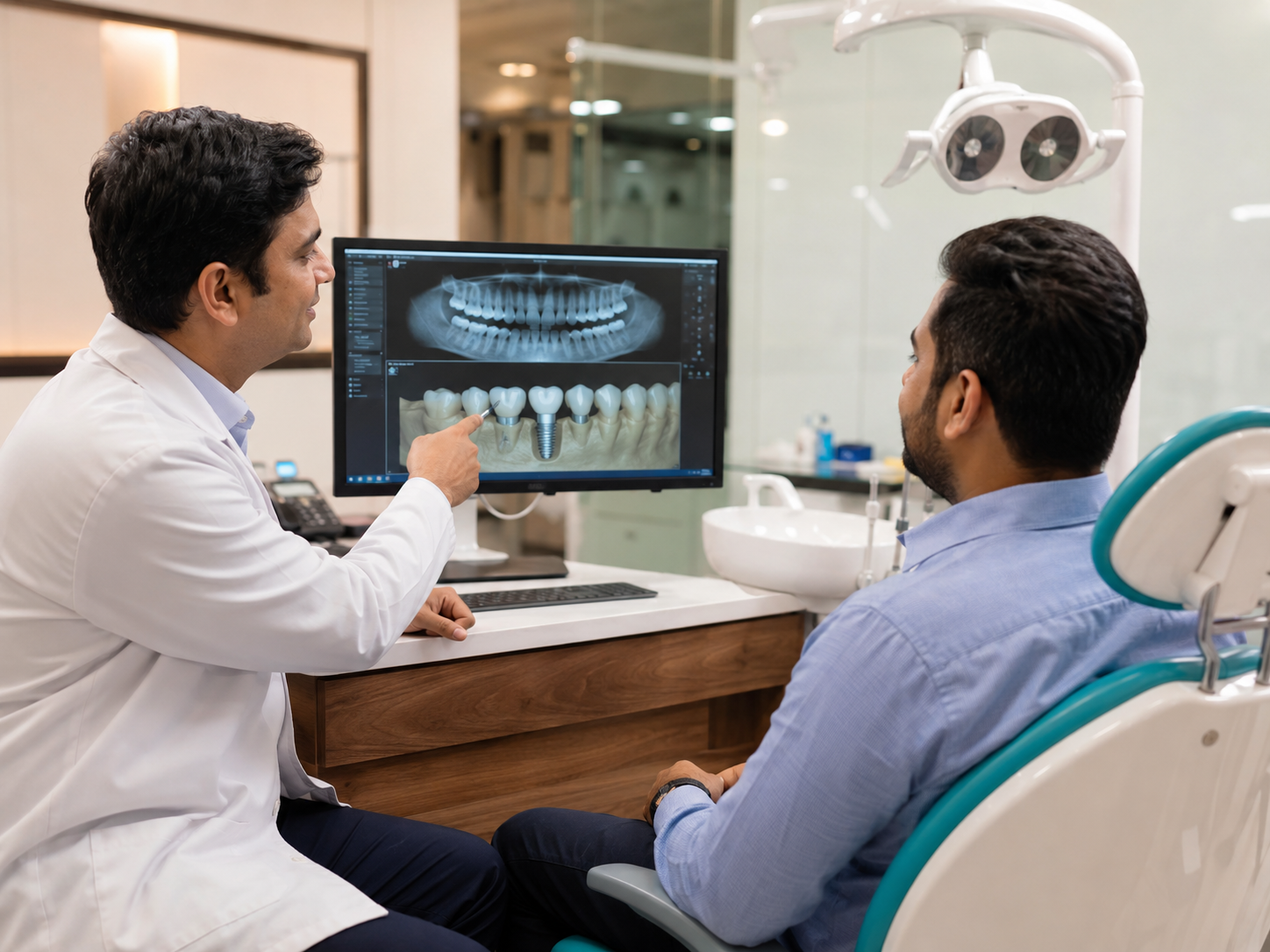
Three-dimensional imaging such as cone beam CT may be used when the clinician needs more information about jawbone, nerves, roots or other nearby anatomy. The planned final restoration matters because implant position influences appearance, chewing, cleanability and future maintenance.
- Dr. Nikitaa Dhingra Sanan, Little Bites Dental Clinic, Faridabad
Who May Be a Good Candidate for Dental Implants?
Many adults with missing teeth may be candidates, but suitability depends on oral health, general health, bone anatomy and the ability to maintain the implant.
Gum Health
Active periodontal disease should be identified and managed. Dental implants can develop inflammatory diseases called peri-implant mucositis and peri-implantitis. Previous periodontal disease, poor plaque control, smoking and diabetes are important risk considerations.
Bone Availability
The jaw needs adequate bone in a suitable location. When bone volume is insufficient, bone grafting, ridge augmentation or sinus augmentation may sometimes be required before or during implant placement.
Diabetes
Diabetes does not automatically rule out dental implants. Implant treatment can be predictable in people with well-controlled diabetes, while poorly controlled diabetes may delay osseointegration and increase the risk of complications.
Smoking
Smoking should be discussed openly before implant treatment. Current evidence links smoking with a higher risk of early dental implant failure, so reducing or stopping smoking can be an important part of planning.
Do You Need One Implant for Every Missing Tooth?
No. The number of implants does not always equal the number of missing teeth. One missing tooth may be restored with one implant and crown. Several missing teeth may sometimes be replaced with an implant-supported bridge using fewer implants than the number of teeth being replaced.
If you are comparing full-mouth implant packages, ask what the quotation actually includes:
- Number of implants.
- Temporary teeth.
- Final prosthesis.
- Extractions.
- Bone grafting.
- Imaging.
- Laboratory work.
- Follow-up and maintenance.
A headline package price cannot tell you whether two treatment plans are clinically equivalent.
Are Same-Day Dental Implants Right for Everyone?
No. Same-day implants can describe different treatment approaches and are not appropriate for every patient. In selected cases, an implant may be placed when a tooth is extracted. A temporary restoration may sometimes also be attached early when bone conditions, implant stability and the bite permit it.
Other patients need healing before implant placement or before the implant supports teeth. Bone normally needs time to bond with an implant through osseointegration. Ask exactly what same day means; it does not necessarily mean that the definitive final teeth will be completed in one appointment.
What Are the Risks and Limitations of Dental Implants?
Dental implants are a well-established treatment, but implant placement is surgery and is not risk free. Possible complications can include:
- Postoperative pain, swelling or bleeding.
- Infection.
- Failure of the implant to integrate with bone.
- Altered sensation or nerve injury in selected lower-jaw sites.
- Sinus-related complications in selected upper-jaw sites.
- Gum recession or aesthetic problems.
- Wear or fracture of prosthetic components.
- Peri-implant mucositis or peri-implantitis.
Long-term maintenance is essential. Implants still need effective home cleaning and regular professional monitoring. A consultation that discusses only benefits and ignores limitations is incomplete.
How Much Do Dental Implants Cost in Delhi NCR?
There is no single clinically meaningful price for every dental implant case. The total cost may change according to number of implants, components, imaging, extractions, grafting, sinus augmentation, temporary teeth, final crown material, surgical complexity, laboratory work and follow-up care.
A low advertised price may refer only to part of the treatment. Before comparing implant clinics in Delhi, Faridabad, Noida or Gurugram, request a written treatment plan showing exactly what is included.
Dental Implant vs Bridge vs Denture: Which Is Better?
There is no single tooth-replacement option that is best for every patient.
| Treatment | Potential Advantage | Important Limitation |
|---|---|---|
| Dental implant | Can replace a missing tooth without preparing adjacent healthy teeth | Requires surgery, suitable anatomy and maintenance |
| Fixed bridge | Fixed replacement without implant placement at the missing-tooth site | Usually relies on neighbouring teeth |
| Removable denture | Can replace several or all missing teeth | Removable and may provide less stability |
| Implant-supported denture | May improve denture support and stability | Requires implant surgery and maintenance |
The appropriate choice depends on neighbouring teeth, bone, gum health, medical factors, finances and patient preferences. A second opinion can be reasonable if extraction of several potentially salvageable teeth is being recommended for an extensive implant reconstruction.
What Should Happen After Dental Implant Treatment?
Implant treatment does not end when the crown or bridge is fitted. Long-term care should include:
- Brushing around implant restorations.
- Appropriate interdental cleaning.
- Regular professional review.
- Monitoring for bleeding or inflammation.
- Maintaining the health of natural teeth and gums.
- Repair of prosthetic components when required.
Bleeding, pus, increasing discomfort, swelling or implant mobility should be assessed rather than ignored.
Why Consider Little Bites Dental Clinic in Faridabad for an Implant Assessment?
Little Bites Clinic is located in Sector 29, Faridabad, and provides dental care for adults and families. For people living in Faridabad and nearby Delhi NCR, convenient access can matter because implant treatment may involve several appointments for planning, surgery, healing checks, restoration and long-term reviews.
Patients should evaluate quality of diagnosis, explanation of alternatives, implant and restorative planning, individual risk assessment, transparent treatment costs and post-treatment maintenance.
Conclusion
If you are searching for the best dental clinic and dentist in Delhi NCR for dental implants, do not judge only by rankings, package prices or same-day promises. Look for diagnosis-led treatment, careful surgical and restorative planning, transparent alternatives, individual risk assessment and long-term maintenance.
Dental implants can be an excellent option for selected patients, but they are not automatically the right choice for every missing or damaged tooth.
Need an implant assessment?
Book an individual dental assessment at Little Bites Dental Clinic, Sector 29, Faridabad.
Book on WhatsAppSources / References
- American Dental Association: Statement on Dental Implant Practices in the News
- American Academy of Periodontology: Dental Implant Procedures
- American Academy of Periodontology: Peri-Implant Diseases
- American Dental Association: Diabetes and Oral Health
- AO/AAP consensus on prevention and management of peri-implant diseases and conditions
- Cambridge University Hospitals: Insertion of Dental Implants
- Smoking in relation to early dental implant failure: A systematic review and meta-analysis, 2024
Author / Medical reviewer: Dr. Nikitaa Dhingra Sanan, BDS, MDS - Pediatric Dentist
Clinic: Little Bites Dental Clinic, Faridabad
Last medically reviewed: 3 September 2026
Medical disclaimer: This article provides general educational information and does not replace an individual dental examination, diagnosis or personalised treatment plan.